
Introduction
Roberto De Zerbi, the accomplished Italian football manager, has made a significant impact on Brighton & Hove Albion Football Club with his tactical prowess. His innovative approach to the game and strategic decisions have transformed the team’s style of play. In this article, we will delve into the details of De Zerbi’s tactics & formation, to understand their effectiveness and influence on Brighton’s performance.
Brighton Possession-Based Dominance

Possession-based dominance is at the core of Roberto De Zerbi’s tactical philosophy at Brighton & Hove Albion Football Club. With a strong emphasis on controlling the flow of the game through superior ball retention, De Zerbi has instilled a possession-oriented approach that has yielded impressive results for the team.
Statistical analysis from the 2022/2023 Premier League season showcases Brighton’s proficiency in maintaining possession. With an average possession rate of 58.5%, the team ranked among the top five in the league. This remarkable statistic underscores their ability to dictate the tempo of matches and limit the opposition’s opportunities to create scoring chances.
Dominating possession offers several advantages for Brighton. Firstly, it allows the team to impose their playing style on the opposition, forcing them to adapt and react defensively. By controlling the ball, Brighton can dictate the rhythm of the game, patiently building attacks and waiting for optimal moments to strike. This approach frustrates opponents, disrupts their defensive shape, and creates spaces for Brighton’s players to exploit.
De Zerbi Dynamic and Fluid Style of Play

Roberto De Zerbi’s tactical approach at Brighton & Hove Albion Football Club encourages a dynamic and fluid style of play that keeps the opposition constantly guessing and on their toes. This style of play is characterized by exceptional positional interchangeability among the players, as they seamlessly switch roles and positions on the field. The fluidity exhibited by Brighton’s players confounds the defensive structure of the opposition, creating difficulties in effectively marking specific players.
The statistical analysis of Brighton’s performance reveals their proficiency in executing this dynamic and fluid style of play. One notable statistic is their high number of successful attacking third passes, indicating their ability to create scoring opportunities through intricate movements and quick combinations. This demonstrates the effectiveness of De Zerbi’s tactics in breaking down the opposition’s defense and creating gaps for penetrating passes or incisive runs.
Building from the Back Brighton
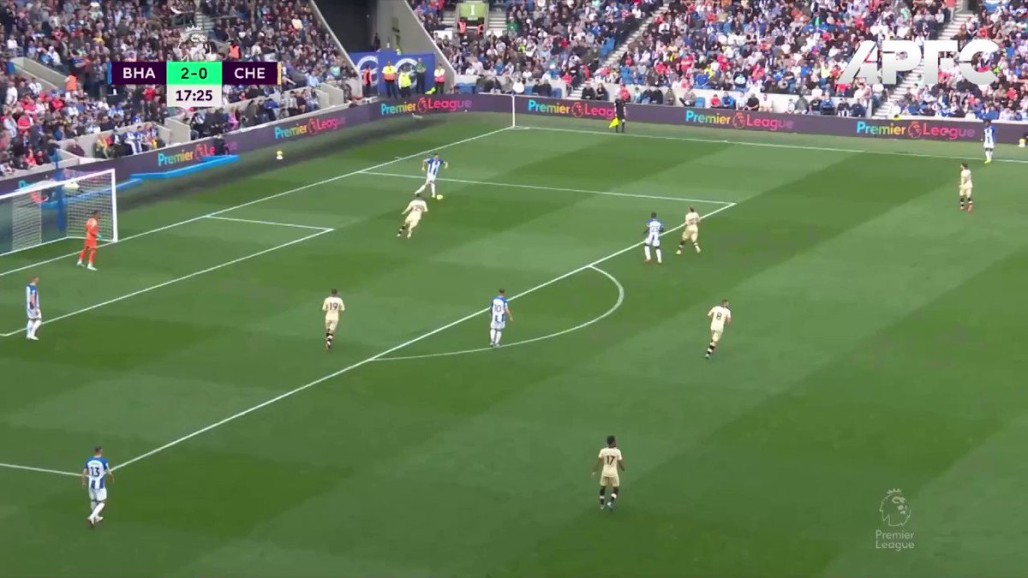
Building from the back is a fundamental aspect of Roberto De Zerbi’s tactics at Brighton & Hove Albion Football Club. It involves the active involvement of the goalkeeper and defenders in initiating attacks and maintaining possession, creating a strong foundation for the team’s overall gameplay.
Statistical data reveals Brighton’s defenders’ impressive passing accuracy rates, consistently exceeding 85% throughout the season. This high level of precision in passing from the defensive line showcases the technical proficiency and composure of Brighton’s players when building their attacks. By effectively distributing the ball from the back, Brighton ensures a smooth transition from defense to attack and maintains control of the game.
In the build-up phase, Brighton adopts a structured 4-2-4 formation. This strategic setup aims to stretch the opposition both vertically and horizontally, creating spaces in between the lines for the team to exploit. The team utilizes deep fullbacks and a narrow double pivot, establishing a close connection with the two center backs. Meanwhile, the two strikers occupy each half-space and drop slightly in between the lines, providing passing options and destabilizing the opposition’s defensive structure. The wingers are positioned high up the field, with their role being to pin the opponent’s last defensive line and stretch them horizontally by hugging the touchline. This strategic positioning forces the opposition’s center backs to stay deeper and restricts their ability to apply pressure on Brighton’s strikers.
One of the key strengths of Brighton’s build-up shape lies in the strong interconnectedness of their players. This is achieved through the formation of wide diamonds and a midfield box. The wide diamonds are formed by a centre back, a defensive midfielder alongside a fullback, and a striker. These diamonds provide the ball-carrier with multiple short passing options, facilitating quick and effective ball circulation. Additionally, the midfield box, formed by the double pivot and both strikers, creates a numerical advantage in the center of the pitch. This overload in the central area allows Brighton to outplay the opposition’s press and maintain control over the midfield battles.
Importance of a ball playing goalkeeper Brighton

One of the key aspects of Brighton & Hove Albion’s build-up strategy is taking advantage of a ball-playing goalkeeper. Incorporating the goalkeeper into the build-up play allows Brighton to create a numerical advantage, effectively playing with an 11v10 formation. The opposition goalkeeper typically doesn’t press, providing an opportunity for Brighton to exploit this spare man on the field. This tactic is why Roberto De Zerbi has favored Jason Steele, who possesses exceptional ability in playing line-breaking passes and maintaining possession under pressure.
The success of utilizing the goalkeeper in the build-up largely depends on how the opposition presses. Typically, one forward from the opposing team will attempt to press the goalkeeper while keeping a center back in his cover-shadow. This pressing movement aims to isolate the goalkeeper as the weakest player on the pitch with the ball and neutralize the numerical advantage created by Brighton’s build-up strategy. However, Brighton often outplays this situation by employing a third man combination, utilizing a player from the double pivot as an alternative passing option to find a free center back.
Other scenarios may involve an opposing striker pressing the goalkeeper while keeping a pivot player in his cover-shadow, or a winger pressing from the outside to the inside, blocking a direct pass to a fullback. In such situations, the key for Brighton is to recognize the presence of a free player and quickly execute ground passes to find and involve them in the build-up play.
However, there are instances when opponents choose not to press Brighton’s goalkeeper at all, effectively making him the spare man on the field. This grants the goalkeeper more time to assess the situation and deliver passes with greater accuracy, allowing his teammates to adjust their positions accordingly. Another option for the goalkeeper in these situations is to play long balls behind the opposition’s defense. With Brighton’s strikers frequently dropping deep and drawing defenders with them, space opens up for the wingers to exploit through well-timed “out-to-in movements.” The key here is to synchronize the run of the wingers with the delivery of the pass, considering the significant travel time of the ball.
Backwards to go forwards
While passing the ball backwards is often perceived as counterintuitive in football, there are strategic advantages to this approach that Brighton & Hove Albion incorporates into their tactics. Although the ball moves away from the opponent’s goal, there are specific situations where a backward pass can be the most beneficial option.
Firstly, passing the ball backwards acts as a pressing trigger for most opponents. Since the ball doesn’t directly threaten their own goal, it provides them with a sense of safety to push forward and engage in pressing. Brighton recognizes this press-baiting nature of backward passes and strategically uses them to lure the opposition into advancing their defensive line.
Secondly, a backward pass opens up better angles for the receiver to continue the attack or find another player who was previously inaccessible. By creating a diagonal angle backward through staggering the centre backs on different horizontal lines, Brighton ensures that the receiver of the back pass has improved passing options and can effectively progress the ball.
Thirdly, playing the ball backwards allows the team to escape congested zones or relieve pressure in specific areas of the pitch. By reversing the direction of play, Brighton can disrupt the opponent’s pressing structure and create space for their players to exploit.
It is important to understand that a backward pass does not indicate fear or a lack of ambition. In the words of Pep Guardiola, it is the beginning of another, better play. Brighton embraces this principle and utilizes diagonal backward passes between their centre backs to generate more space in between the lines or behind the opposition.
By employing this strategy, Brighton’s centre backs position themselves on different horizontal lines, with one central defender slightly deeper to create a diagonal angle for a backward pass. The ball-carrying centre back often waits with the ball, enticing the opposition before playing the backward pass to his partner. This sequence increases pressure as another opponent may engage the new ball-carrier, ultimately creating additional space for Brighton to exploit.
The diagonal backward pass takes slightly longer to travel than a simple horizontal pass between the centre backs, initially moving away from the opposition. This extra time allows the receiving central defender to orient himself and assess potential passing options. Additionally, receiving the ball with an open body orientation rather than a side-one orientation enables faster progression of the ball.
In situations where the pressure becomes too high, the centre backs can also opt to play the ball backward to the goalkeeper. This serves as a safety measure and has the potential to stretch the opponent vertically, creating additional space for Brighton to exploit.
Strong core of 6

When the centre backs are unable to find a passing option through the middle or into the double pivot, one alternative they look for is the strikers positioned in the half-spaces. This requires the centre backs to possess the ability to play vertical balls with sufficient pace and the courage to attempt them.
The strikers also act as passing options for the double pivot to combine with. In these situations, they often receive the ball in more space as the opposition tends to focus on suppressing Brighton’s central combinations. If the Seagulls can successfully progress past the pressure, it creates larger gaps between the lines, offering more opportunities for forward movement.
While the strikers typically occupy deeper positions for extended periods, they will occasionally make forward runs into the last line to dynamically occupy spaces in between the lines. This makes them harder to mark and creates a dilemma for the opposition. If defenders follow the striker’s movement, space opens up behind them for the wingers to exploit. If defenders stay to defend the depth, the striker can receive the ball with space and turn, gaining a forward-facing view of the game. The strikers may also move slightly horizontally into the centre to receive passes from the centre backs, who play through the double pivot. Brighton’s forwards display tactical intelligence in recognizing when to occupy the half-spaces or move into the middle, adapting their positioning based on the opponent and providing passing options by moving out of cover-shadows.
Even when the strikers drag defenders with them, creating spaces behind, these gaps are not easily accessible for Brighton’s centre backs if they are under pressure. Therefore, the central defenders frequently play into the strikers, even if they have a marker tight behind them.
While the strikers are capable of playing with their backs to the goal, they require proper support to continue the progression and effectively attack the last line. The player receiving the lay-off pass has a forward-facing view, which allows him to assess various options. Vertical passes often attract significant pressure around the recipient as they have a negative body orientation, and the ball moves closer to the opposition’s goal, perceived as a threat. To overcome these scenarios, different movements from teammates, such as dismarking and shadow-manipulations, are crucial.
After the centre back plays a vertical pass to the forward, a set of players dynamically take up positions to support the striker facing backwards. Typically, both defensive midfielders (6s) move forward to offer passing options, the ball-near fullback advances, or the striking partner drops diagonally inside to provide support. These diverse follow-up options for the striker, on different vertical and horizontal lines, allow Brighton to adapt to the opponent and address various situations. The diagonal support from the ball-near 6 is particularly effective, preventing the striker’s direct opponent from easily pressing onto the 6.
Catch you in the next one
You must be logged in to post a comment.