
Lionel Scaloni, the head coach of the Argentina national football team, employed a series of tactical strategies and formations during the 2022 World Cup. With a rich history in football and a talented squad at his disposal, Scaloni’s tactics played a vital role in Argentina’s success in the tournament. In this article, we will delve into the tactical aspects of Argentina’s gameplay, analyzing Scaloni’s approach, formations, and key strategies that contributed to their impressive performance on the international stage.

Formation and Lineup Argentina
Lionel Scaloni, the head coach of the Argentina national football team, implemented a 4-3-3 formation during the World Cup, which provided a solid foundation for both attacking and defensive gameplay. The lineup consisted of four defenders, comprising two center-backs and two full-backs who contributed to the team’s defensive solidity while also providing support in the attacking phase. In the midfield, Scaloni deployed a trio that offered stability and creativity, while the front three spearheaded the team’s attack with their goal-scoring prowess.
Defensive Organization
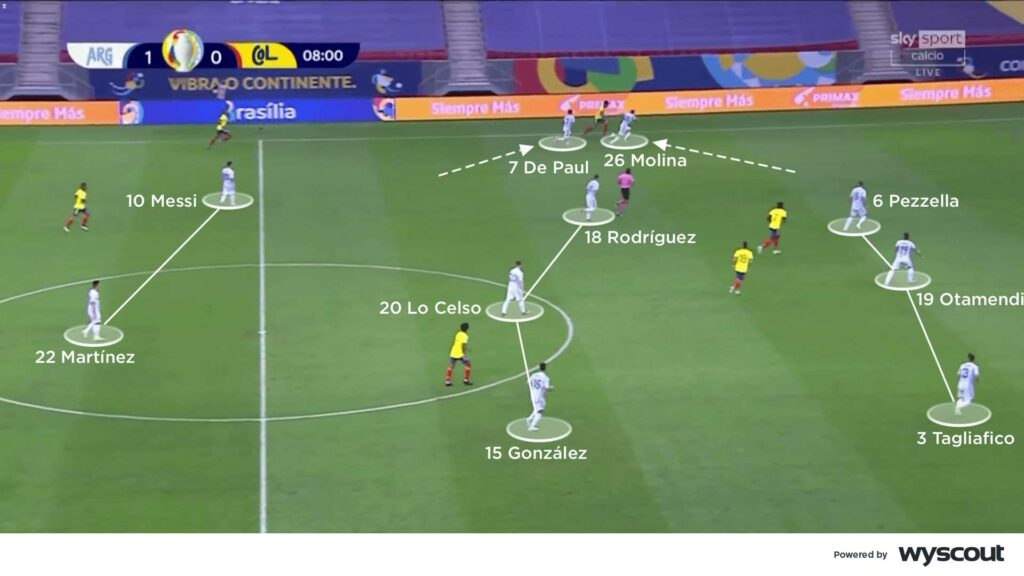
Under Scaloni’s guidance, Argentina showcased a well-structured defensive system, primarily employing a 4-4-2 formation. The coach emphasized the collective effort of both midfielders and forwards in defensive duties, ensuring compactness and making it challenging for opponents to breach their defensive lines. The defensive organization was built on disciplined positioning, coordinated pressing, and effective man-marking.
Throughout the tournament, Argentina’s defensive statistics were impressive. They managed to keep three clean sheets, conceding an average of only 1.1 goals per game. The team exhibited a strong tackling presence, with an average of 17.6 tackles per game. Additionally, their ability to read the game was evident, as they made an average of 7.4 interceptions per game. When needed, Argentina’s defenders displayed their clearance skills, making an average of 16.0 clearances per game. The goalkeeper played his part as well, making an average of 1.0 save per game.
Pressing and Counter-Pressing
Lionel Scaloni, the head coach of the Argentina national football team, placed great emphasis on high-intensity pressing and counter-pressing as part of his tactical approach during the World Cup. The team’s relentless pressing aimed to regain possession quickly and disrupt the opponents’ build-up play. Argentina’s players executed Scaloni’s instructions with great determination, seeking to win the ball back as close to the opposition goal as possible.
This aggressive pressing not only prevented opponents from settling into a rhythm but also created numerous attacking opportunities for Argentina. By putting pressure on the opposing players and forcing turnovers, Argentina could launch swift counter-attacks, catching their opponents off guard. The ability to transition from defense to attack quickly was a key component of Argentina’s gameplay, and Scaloni’s tactical emphasis on pressing and counter-pressing played a vital role in achieving this.
In terms of duels won, Argentina displayed their tenacity and competitiveness on the field. The team won an average of 52.3 duels per game, with a success rate of 51.1%. In ground duels, Argentina won an average of 40.0 duels per game, with a success rate of 51.9%. Additionally, the team showed their aerial prowess by winning an average of 12.3 aerial duels per game, with a success rate of 48.6%.
Midfield Structure and Creativity
The midfield was a crucial component of Argentina’s gameplay during the World Cup. Scaloni crafted a midfield that blended defensive solidity with attacking flair, incorporating a combination of ball-winners and creative playmakers. This midfield structure allowed Argentina to effectively transition the ball from defense to attack, maintain possession, and create goal-scoring opportunities for the forwards.
With a ball possession average of 57.6%, Argentina’s midfielders showcased their ability to control the game and dictate the tempo. They maintained a high level of accuracy in their passing, with an average of 532 accurate passes per game at an 86.1% success rate. This accuracy in passing was instrumental in maintaining possession and orchestrating attacking moves.
The midfielders’ role in Argentina’s gameplay extended beyond ball distribution. They were responsible for breaking up opponents’ plays, intercepting passes, and providing defensive cover. At the same time, they contributed to the team’s attacking endeavours by linking up with the forwards, providing incisive passes, and creating scoring opportunities.
Argentina Exploiting Wide Areas
One of the key aspects of Lionel Scaloni’s tactical approach with the Argentina national football team during the World Cup was the effective exploitation of wide areas. Argentina frequently utilized the width of the pitch to stretch the opposition defense and create space for their attacking players. This strategic move allowed them to deliver crosses into the box and exploit the defensive vulnerabilities of their opponents.
Scaloni encouraged the full-backs to venture forward and overlap with the wingers, providing additional attacking options in the final third. By doing so, Argentina’s attacking players had the freedom to move into dangerous positions, while the full-backs provided support and delivered accurate crosses into the box. This tactic not only created scoring opportunities but also put immense pressure on the opposition’s defensive structure.
In terms of accurate long balls, Argentina successfully executed an average of 16.4 per game with a success rate of 51.8%. This showcased their ability to find teammates in wide areas and initiate attacks from those positions. Additionally, Argentina delivered an average of 2.9 accurate crosses per game, further highlighting their proficiency in utilizing wide areas to create goal-scoring opportunities.
Offensive Transition

Scaloni’s tactics placed significant emphasis on quick and efficient offensive transitions. Argentina displayed excellent cohesion and understanding, swiftly transitioning from defense to attack. The team capitalized on counter-attacking opportunities, exploiting the opponents’ defensive errors and catching them off guard.
With five counter-attacks per game, Argentina showcased their ability to pounce on the opponents’ vulnerable defensive positions. The forwards played a vital role in this aspect, using their pace and intelligent movement to exploit the spaces left behind by the opposition’s defensive line. Additionally, the team successfully completed an average of 6.4 successful dribbles per game, further demonstrating their ability to bypass defenders and create goal-scoring chances.
The seamless transition from defence to attack allowed Argentina to launch swift and incisive counter-attacks, putting immense pressure on the opposition’s defence and creating numerous scoring opportunities.
Argentina Set-Piece Strategy
One of the strengths of Lionel Scaloni’s tactical approach with the Argentina national football team during the World Cup was their proficiency in set-piece situations. Whether it was defending against opponents’ set-pieces or capitalizing on their own, Argentina displayed a high level of expertise and effectiveness.
Scaloni’s attention to detail and strategic planning played a crucial role in Argentina’s success in set-piece situations. The team scored vital goals from set-pieces, which proved to be decisive in important matches. The coach’s meticulous preparations and the players’ execution of set-piece routines allowed them to create scoring opportunities and convert them into goals.
Defensively, Argentina remained resolute in defending against opponents’ set-pieces. Scaloni instilled discipline and organization within the team, ensuring that players were in the right positions and marking their opponents tightly. This defensive solidity prevented the opponents from capitalizing on set-piece situations and maintained Argentina’s defensive stability.
Adapting to Opponents
One of Lionel Scaloni’s notable qualities as a coach was his tactical flexibility and ability to adapt to different opponents. He analyzed the strengths and weaknesses of the opposition and made necessary adjustments to counter their threats effectively.
Scaloni made subtle adjustments to the team’s formation based on the opponents’ style of play and personnel. Whether it involved altering the pressing intensity, changing the positioning of players, or assigning specific man-marking tasks, Scaloni displayed astute tactical acumen in adapting his strategies.
The team’s ability to win ground duels, with an average of 40.0 duels won per game and a success rate of 51.9%, showcased their effectiveness in engaging opponents in physical battles. Additionally, Argentina’s aerial duels won an average of 12.3 per game, with a success rate of 48.6%. This ability to succeed in both ground and aerial duels allowed Argentina to gain an advantage over opponents and assert their dominance on the pitch.
In terms of fouls committed, Argentina averaged 14.3 fouls per game. While maintaining a competitive edge, the team also displayed discipline and avoided unnecessary fouls that could potentially harm their defensive stability.

Throughout the World Cup, Lionel Scaloni showcased his tactical acumen and strategic approach as the head coach of the Argentina national football team. His style of play, ability to adapt to opponents, and well-thought-out strategies contributed to Argentina’s success on the international stage.
Scaloni implemented a dynamic and versatile style of play that emphasized attacking intent while maintaining defensive solidity. The 4-3-3 formation provided a solid foundation, enabling Argentina to excel in both attacking and defensive phases of the game. The team’s utilization of wide areas, high-intensity pressing, and quick offensive transitions created numerous goal-scoring opportunities and kept opponents on the back foot.
One of Scaloni’s notable strengths was his ability to adapt his tactics based on the strengths and weaknesses of the opponents. Whether it involved making subtle adjustments to the formation, altering pressing intensity, or assigning specific man-marking tasks, Scaloni demonstrated his tactical flexibility. This adaptability allowed Argentina to nullify opponents’ threats effectively and exploit their vulnerabilities.
In set-piece situations, Scaloni’s attention to detail and strategic planning paid dividends. Argentina displayed proficiency both defensively and offensively, scoring crucial goals from set-pieces while remaining resolute in defending against opponents’ attempts. This showcased the team’s meticulous preparations and execution of set-piece routines.
Moreover, Scaloni instilled a cohesive and united spirit within the team, fostering excellent understanding and cohesion among the players. This unity was evident in their quick offensive transitions, where the players seamlessly moved from defense to attack, exploiting opponents’ defensive errors and capitalizing on counter-attacking opportunities.
As the head coach, Scaloni’s tactical approach and strategic decisions provided Argentina with a strong foundation for success. His ability to adapt, attention to detail, and emphasis on exploiting strengths while countering opponents’ weaknesses proved vital in guiding Argentina’s impressive performance in the World Cup.
Catch you in the next one.